US President's Malaria Initiative
CDC supports malaria control efforts for the mainland National
Malaria Control Programme and the Zanzibar Malaria Control Programme as
part of the US President’s Malaria Initiative (PMI). Since 2005, this
effort has produced phenomenal gains in access to malaria prevention
and treatment interventions in Tanzania and across the Zanzibar
Archipelago. For more information on PMI activities in Tanzania, see
www.pmi.gov
.
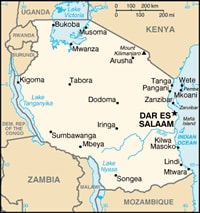
Tanzania
CDC/IHI Malaria Program in Tanzania
In addition to the agency’s key role in guiding and implementing PMI in the United Republic, CDC and the
Ifakara Health Research and Development Centre (IHI)
have collaborated on a series of cooperative agreements since 2000. The
CDC/IHI Malaria Programme in Tanzania has emerged as a globally
recognized leader in implementation and applied research to guide
malaria control programs for both the mainland and Zanzibar Ministries
of Health and Social Welfare and public health programs across the
continent.
Between 2000 and 2006 the CDC/IHI Malaria Programme in Tanzania achieved the following milestones:
- Completed the first programmatic implementation of
artemisinin-containing combination therapy (ACT) in tropical Africa,
delivering over a million treatment doses of highly effective malaria
treatment in an isolated rural district for more than 4 years.
- Established the complementary role of free and market-based
strategies for delivering insecticide-treated mosquito nets (ITNs) for
malaria prevention.
- Characterized the public- and private-sector markets for
malaria treatment and demonstrated how national policies can affect the
equitable access to treatment for impoverished rural communities.
- Documented the distribution of drug-resistant strains of malaria across rural Tanzania and the rest of Africa.
- Established the relative contribution of diagnostically
confirmed malaria among patients presenting to first-line health
facilities and drug stores in rural Tanzania.
- Completed the first national survey on quality of antimalarial
drugs available in the retail sector and established the extent of
distribution of artemisinin monotherapies in urban Dar es Salaam.
- Contributed to a global model of malaria risk, coordinated by Oxford University.
- Established best practices for achieving high adherence to complex 3-day treatment regimens with at least 2 ACTs.
- Compared 3 possible regimens for the intermittent preventive treatment of malaria in pregnancy.
- Established the impact of ACT and ITNs on nearly eliminating malaria transmission in the Zanzibar Archipelago.
- Provided detailed implementation evidence for the roll-out of rapid diagnostic tests for malaria in rural Africa.
- Demonstrated how interventions to improve the care of severely
ill children could be effectively implemented in the context of the
Integrated Management of Childhood Illness.
- Monitored the costs and policy implications of delivering ACT
as routine first-line treatment for malaria at district and national
levels.
- Elaborated the health-equity implications of delivering malaria treatment and prevention.

IMPACT Tz team members conducting a household survey in Rufiji District, 2006.
Credit: S. Patrick Kachur, CDC
These activities were completed as part of the Interdisciplinary
Monitoring Project for Antimalarial Combination Therapy in Tanzania
(IMPACT-Tz), supported by CDC, the US Agency for International
Development, and the Wellcome Trust. In addition to IHI, key partners
included the Australian National University, the London School of
Hygiene and Tropical Medicine, and the Swiss Tropical Institute.
Since the completion of IMPACT-Tz, the CDC/IHI
Malaria Programme in Tanzania has continued to support the Malaria
Control Programmes in both Ministries by providing:
- Funding for in vivo and in vitro assays of antimalarial drug resistance.
- Opportunities for Tanzanian scientists to train alongside US-based laboratorians.
- Support for quality assurance of rapid diagnostic tests for malaria.
- Technical guidance for the operational research component of
mainland Tanzania’s Round 4 award from the Global Fund to Fight
HIV/AIDS, Tuberculosis and Malaria (GFATM).
Beginning in 2009/2010 the CDC/IHI Malaria Programme will implement
an evaluation of mainland Tanzania’s Round 7 award from GFATM to
explore the impact of introducing rapid diagnostic tests for malaria
and a highly subsidized ACT in the private retail sector. This will be
done collaboratively with the ACT Consortium at the London School of
Hygiene and Tropical Medicine, through a grant from the Bill and
Melinda Gates Foundation. CDC and IHI are looking forward to future
collaborative opportunities along this model.
For more information about the CDC/ IHI Malaria Programme in Tanzania, contact:
Elizeus Kahigwa, MD, PhD
Ifakara Health Research & Development Centre
PO Box 78373
Dar es Salaam, Tanzania
Tel: 255 222 774 714
Mobile: 255 744 481 965
Fax: 255 222 771 7143
E-mail:
ekahigwa@ihrdc.or.tz /
ekahigwa@yahoo.com
Peter D. McElroy, PhD, MPH
CDC Advisor to President's Malaria Initiative (PMI)
CDC-Tanzania
Tel: 255 22 212 1412 ext. 8474
Mobile: 255 (0)75 422 2247
E-mail:
mcelroyp@tz.cdc.gov
S. Patrick Kachur, MD, MPH, FACPM
CDR, USPHS
Chief, Strategic and Applied Sciences Unit
Malaria Branch, Division of Parasitic Diseases
National Center for Zoonotic, Vector-Borne & Enteric Diseases
Coordinating Center for Infectious Diseases
Centers for Disease Control and Prevention
4770 Buford Highway, NE Mailstop F-22
Atlanta, Georgia 30341 USA
Tel: 1 770 488 3600
Fax: 1 770 488 4206
E-mail:
spkachur@cdc.gov


 Facebook
 Wikipedia
 Twitter
 Tanzania, United Republic of - In Tanzania, the Island of Zanzibar leads the charge against malaria


Prof Wen Kilama
He is among other things a former Chairman of the Malaria Foundation International, Past President of the World Federation of Public Health Associations, and member of the WHO global Advisory Panel on Health Research. Professor Kilama is Honorary Fellow of the Royal Society of Tropical Medicine and Hygiene.
He has served in various capacities on numerous committees and task forces for the World Health Organization, the World Bank, US agencies, and the European Commission among others. He is an exceptional advisor for malaria research capacity strengthening throughout Africa, as well as an expert source of knowledge and advice on issues pertaining to both health research ethics and sustainable development in malaria research.
Prof James Oloo, MD, PhD
Dr Dawit Ejigu, MD, MSc
Dr Ejigu obtained his Medical Doctorate degree from University of Gondar, Ethiopia in 2001 and graduated with Masters in Pharmacology from the Addis Ababa University (AAU), Ethiopia in 2005. He worked as Assistant Lecturer at Department of Pharmacology, University of Gondar immediately after his medical studies. He also worked as Assistant Professor of Pharmacology in the AAU, Faculty of Medicine.
Dr Ejigu attended a one year fellowship organized by GSK-Bio/TDR in GlaxoSmithKline Biologicals, Belgium on tuberculosis vaccine development in 2007/2008 where he worked as Global Study Manager. Following his training at GSK-Bio he worked as Clinical Monitor for TDR. Dr Ejigu has also worked as Clinical Trial Associate and Project Manager for European Malaria Vaccine Initiative (EMVI)/European Vaccine Initiative (EVI).
Dr Ramadhani Noor, MD, MPH
Dr Aceme Nyika, BSc, PhD, MPH
Mr Badru Amri, BCom, ACPA, ACCA
Dr Brenda Okech, PhD
Mr Bonney Majila, BCom, MBA
Ms Leila Mfinanga, BA
Before joining AMANET, Ms Mfinanga worked as Administrative Officer for the School of Public Health and Social Sciences at Muhimbili University of Health and Allied Sciences in Tanzania (2003 – 2007), and as a Research Fellow (2001 – 2003). She holds a Bachelor of Arts Degree (International Relations and Public administration, 2001) of the University of Dar es salaam.